

Houston Rental Market Update: What Property Owners Need to Know
The Houston rental market continues to send mixed signals.
Rental demand is improving. New inventory has finally started to decline year over year. Rents remain relatively flat. At the same time, active inventory remains elevated, and we're approaching the part of the year when rental demand traditionally begins to slow.
For Houston rental property owners, that means execution matters.
At Emerson Property Management, we track both the broader Houston market and the performance of the properties we manage. Here's what we're seeing right now.
Emerson Portfolio Performance
Our latest portfolio numbers:
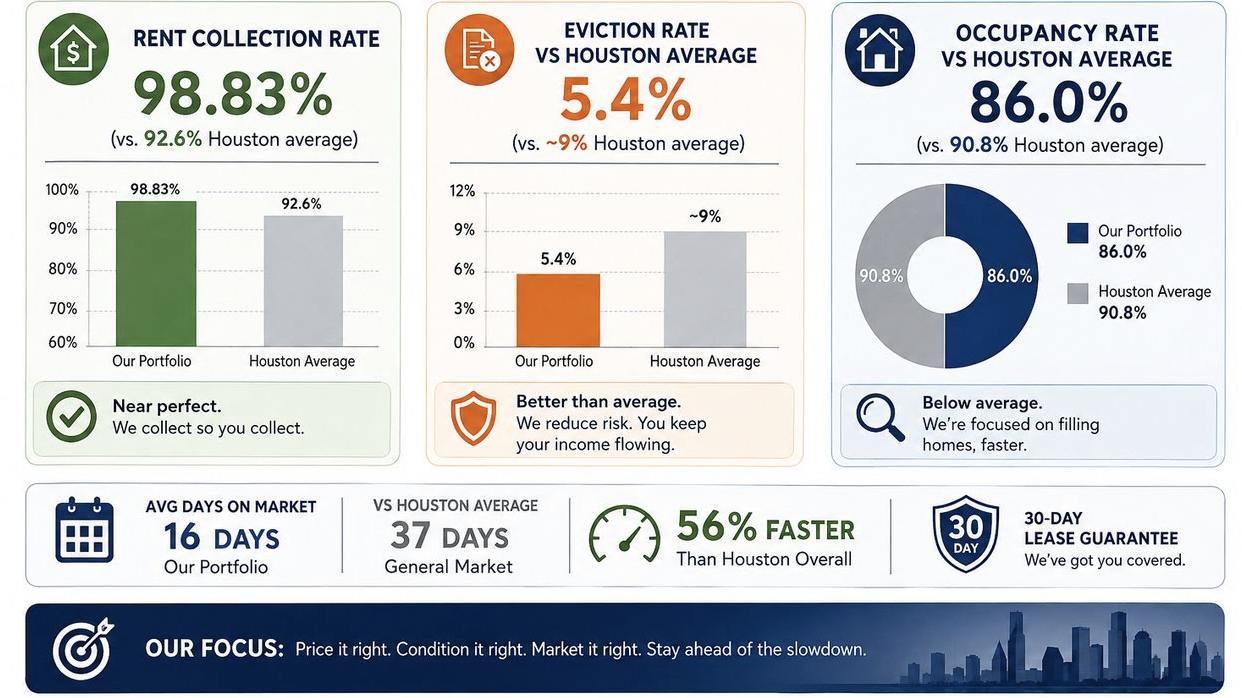
- Rent Collection Rate: 98.83%
- Eviction Rate: 5.4%
- Occupancy Rate: 86.0%
- Average Days on Market: 16 days
For comparison, the Houston market averaged approximately 37 days on market, meaning Emerson properties leased approximately 56% faster during the period.
Our occupancy rate remains below the broader Houston average, partly because we onboarded more than 20 new clients in approximately six weeks.
That's why occupancy alone doesn't tell the whole story.
We're also closely watching how quickly available properties lease.
And that's becoming increasingly important as Houston moves out of peak leasing season.
Houston Rental Market Snapshot:
Here's what the latest Houston rental data tells us:
| Metric | Previous | Current | Change |
|---|---|---|---|
| New Rental Listings | 7,882 | 7,664 | -2.8% YoY |
| Leased Listings | 4,626 | 5,185 | +12.1% YoY |
| Average Rent | $2,426 | $2,419 | -0.3% YoY |
| Houston Avg. Days on Market | 37 days | ||
| Emerson Avg. Days on Market | 16 days |
There are two numbers Houston landlords should pay particularly close attention to. We do have about a dozen homes active right now, and several of those have crossed 30 days. Owners on those assets get relief - we will honor our 30 day guarantee.
There are two numbers Houston landlords should pay particularly close attention to.
First, new listings declined 2.8% year over year.
That's encouraging because it means slightly less new rental competition is entering the market.
Second, leased listings increased 12.1%.
That's arguably the stronger signal.
More properties are being absorbed even while average rents remain essentially flat.
What does that mean for Houston landlords?
The market isn't suddenly easy.
Inventory remains elevated, and properties still need to compete for qualified residents.
That makes the fundamentals more important:
Price correctly. Present the property well. Use professional photography. Complete the make-ready before marketing. Respond to prospects quickly.
The properties that miss on those fundamentals are likely to feel the slowdown first.
The Seasonal Risk Houston Landlords Should Be Watching
Rental demand typically begins cooling after July and August and continues softening toward the end of the year.
That's why we're paying particularly close attention to properties approaching or exceeding 30 days on market.
A property that's slightly overpriced during peak leasing season might eventually find a resident.
That same pricing mistake becomes considerably more expensive when demand slows.
The objective shouldn't be to chase the highest theoretical rent.
It should be to maximize the property's total economic performance.
Sometimes accepting slightly less rent today produces considerably more annual income than holding a property vacant while waiting for an extra $100 per month.
Maintenance Performance
Our latest maintenance numbers:
- Median repair time: 5.4 days
- Resident satisfaction: 3.65/5.0
- Work orders canceled: 30.1%
Our repair speed continues to perform well, particularly considering the volume of HVAC-related maintenance that comes with a Houston summer.
Resident satisfaction, however, wasn't where we want it.
We reviewed every one-star maintenance rating from the month.
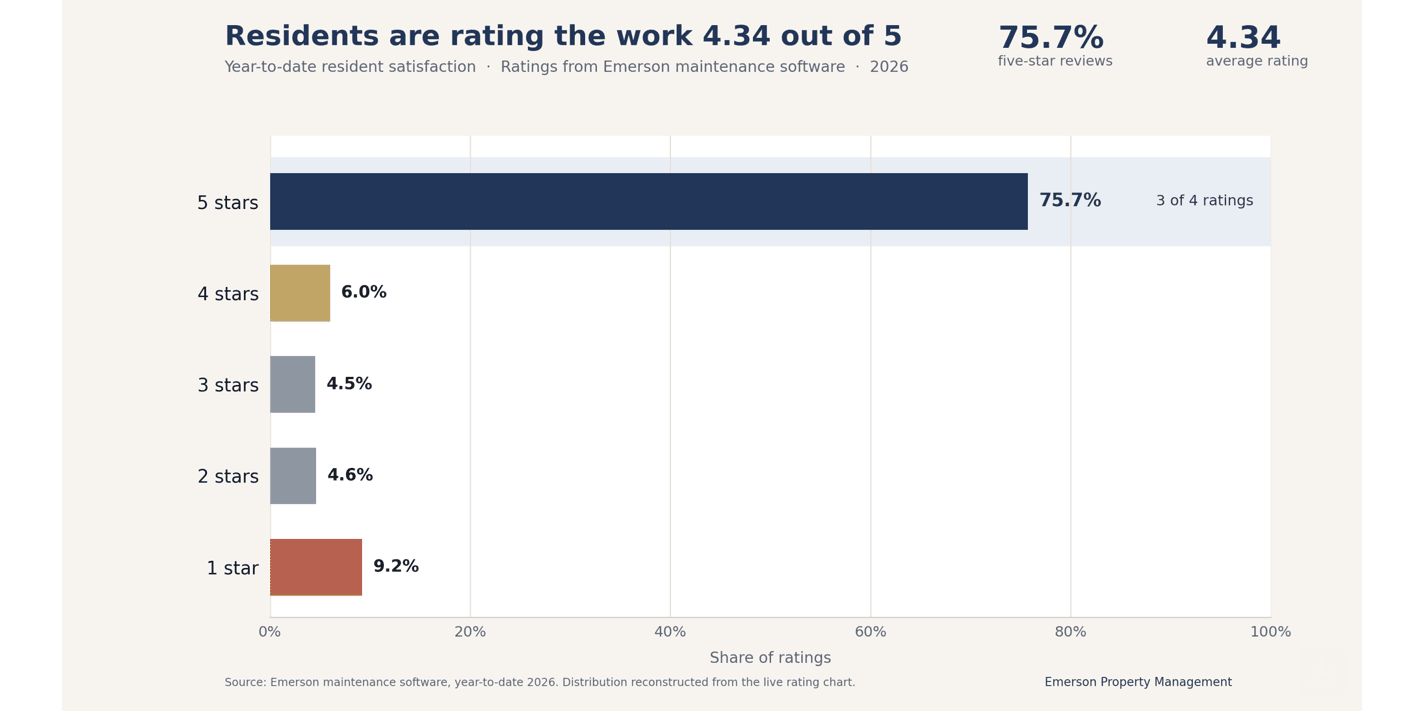
Two involved AC replacements, one involved a refrigerator replacement, and another involved a window repair.
There wasn't one major systemic failure, but there were opportunities to improve communication and execution.
That's an important distinction.
Property management isn't about pretending problems don't happen.
It's about having enough visibility into the operation to identify problems, understand why they happened, and improve the process.
Year to date, more than 75% of our maintenance reviews have been five stars, while fewer than 10% have been one star.
We'll continue watching both numbers closely.
.jpg)
Owner Retention and Lease Renewals
Two other numbers we're particularly proud of:
Owner retention: 92.4%
Lease renewal rate: 65.1%
Our renewal rate deserves some additional context.
Several months ago, we were hovering around 50%.
That wasn't good enough.
We made resident renewals a major operational focus, and the rate has since climbed to 65.1%, putting Emerson around the upper end of the national range cited in our internal reporting.
Why do renewals matter so much?
Every qualified resident who renews can mean:
- One less vacancy
- One less make-ready
- One less leasing cycle
- Fewer marketing expenses
- Less uncertainty for the property owner
Small improvements in retention can create meaningful improvements in a rental property's long-term economics.
Houston Rental Case Study: Timing Matters
One of the clearest examples this month came from a property at 1322 Magnolia Street in Baytown.
The home previously leased for:
$1,299/month
After that tenancy ended, we turned the property and brought it back to market.

The new result:
$1,395/month
That's a $96 monthly rent increase, with only 20 days of vacancy.
But here's the interesting part.
The last time we marketed the same property during Q4, it sat vacant for:
141 days.
Same house.
Same finishes.
Same leasing team.
Very different outcome.
The difference was timing.
This is why lease expiration dates matter more than many rental owners realize.
Whenever possible, we want to avoid positioning a property's next vacancy during periods when rental demand historically weakens.
An extra $50 or $100 per month doesn't mean much if achieving it creates months of additional vacancy.
Should Houston Property Owners Sell or Hold?
This is one of the biggest questions we're hearing from owners right now.
The Houston for-sale market has become increasingly challenging for sellers.
Inventory has increased while sales activity has struggled to keep pace.
The basic economics aren't complicated:
More homes for sale + fewer buyers = more competition among sellers.
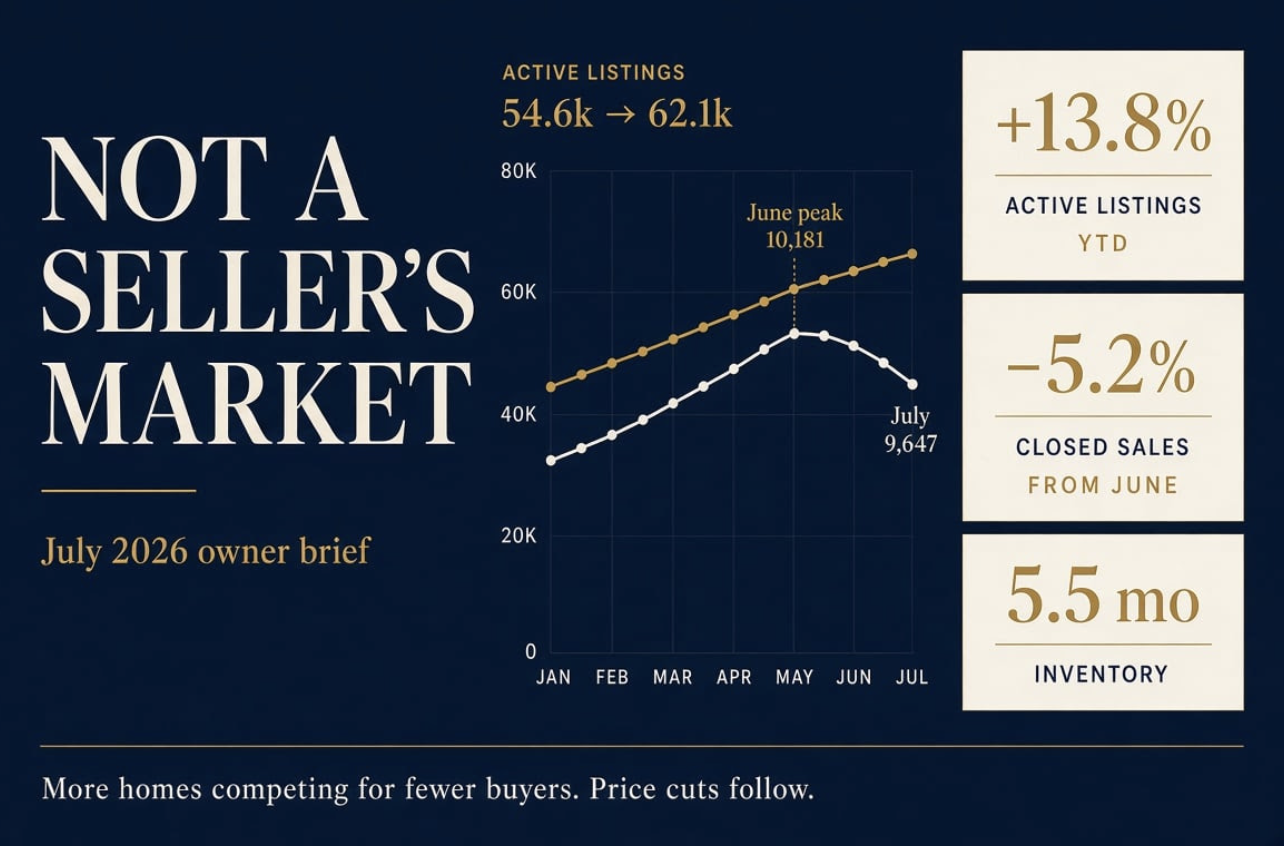
And Houston was already struggling with homes selling at their original asking price.
The graphics below from The Journal of Texas Real Estate Research show the data.
_1.jpg)
.jpg)
That can mean longer marketing periods, more price reductions, concessions, and a lower probability of receiving the original asking price.
We obviously operate a property management company, so owners should understand that we have an interest in people continuing to own rental properties.
But the market data still deserves consideration.
If you don't need to sell within the next six months, it may be worth evaluating whether holding the property and reassessing the market later makes more financial sense.
That doesn't guarantee prices will improve.
It simply means today's selling environment should be factored into the decision.
For investors looking to acquire properties, the opposite may be true.
More motivated sellers and elevated inventory could create opportunities for buyers who have capital, patience, and the ability to hold assets long term.
For sellers, patience may be valuable.
For buyers, it may be time to start watching closely.
What We're Watching Next
Heading toward the final portion of the year, we're watching four things particularly closely:
- Houston rental inventory
- Days on market
- Lease renewal rates
- Seasonal changes in rental demand
The biggest mistake owners can make is waiting until a property has been vacant for 30, 45, or 60 days before responding to what the market is telling them.
The better approach is to stay ahead of it.
Price based on current competition.
Keep the property in excellent condition.
Respond quickly to qualified prospects.
And make decisions based on the property's annual performance, not simply the highest possible monthly rent.
The Bottom Line for Houston Rental Property Owners
The Houston rental market isn't booming, but there are encouraging signals.
New rental inventory declined 2.8% year over year.
Leased properties increased 12.1%.
Average rents remained essentially flat.
And Emerson-managed properties averaged 16 days on market compared with approximately 37 days across the broader market during the period covered by this update.
The opportunity is there.
But the margin for error is getting smaller as we move toward the slower leasing months.
For Houston property owners, this is the time to focus on fundamentals: pricing, property condition, resident retention, maintenance execution, and vacancy management.
Those aren't particularly flashy strategies.
They're simply the things that consistently protect rental property performance.
Need Help With a Houston Rental Property?
If you own a rental property in the greater Houston area and want to understand its current rental value, expected leasing timeline, or whether holding versus selling makes sense, Emerson Property Management can help you evaluate the numbers.
Visit Emerson Property Management to learn more or request a rental analysis.
.jpeg)