
Cameron Tope, Emerson Property Management · Host: Jeremy Rivera · Unscripted Small Business Podcast
Best Quotes
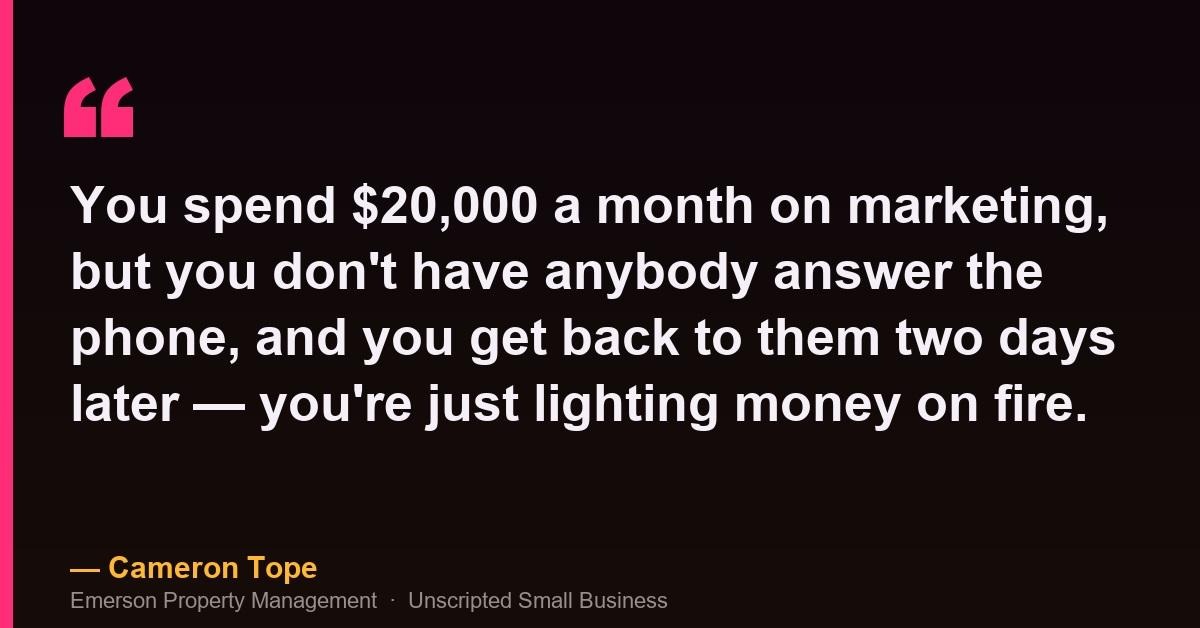
"You spend $20,000 a month on marketing, but you don't have anybody answer the phone, and you get back to them two days later — you're just lighting money on fire."
— Cameron Tope, on speed-to-lead
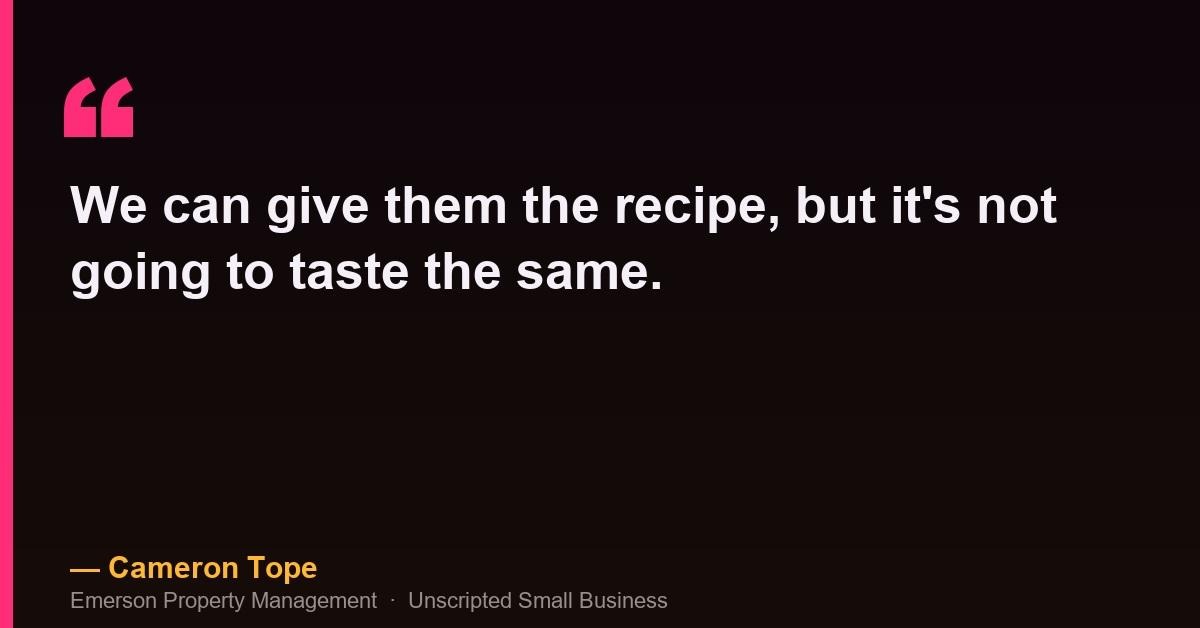
"We can give them the recipe, but it's not going to taste the same."
— Cameron Tope, on giving away the playbook
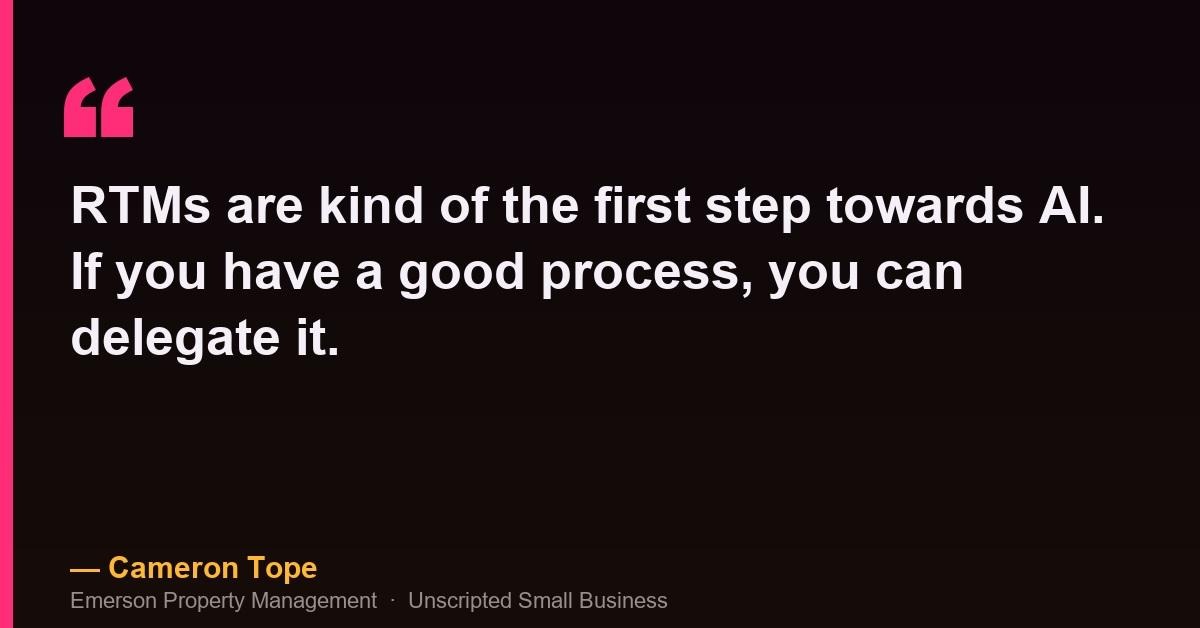
"RTMs are kind of the first step towards AI. If you have a good process, you can delegate it."
— Cameron Tope, on remote team members
Unscripted Small Business interview with Cameron Tope
Jeremy Rivera: Hello, I'm Jeremy Rivera, your Unscripted podcast host, and I have a returning guest here, Cameron Tope, who's going to introduce himself again to those that didn't have the honor and pleasure of listening to his previous interview.
Jeremy Rivera: Give an introduction, tell us who you are, your niche and focus, and a little bit of your experience — and then we'll dive into some new subjects.
Returning listeners will remember Cameron from his first visit, Building a Property Management Company With Integrity; this second conversation picks up on marketing, AI, and running a Houston company entirely from San Diego.
Cameron Tope: Jeremy, thanks for having me on, man. My name's Cameron Tope.
Cameron Tope: Broker, owner, founder of Emerson Property Management. We're a residential property management company in the Greater Houston area, but I operate 100% remotely from San Diego, California.
Cameron Tope: So we can touch on business stuff, a little bit of the property management, and also rental property investing. We support several hundred owners there in the Greater Houston area.
Cameron Tope: And not to rehash too much, but basically Emerson Property Management was started because I couldn't find a property manager to do what I wanted to do.
Cameron Tope: I was at risk of losing my job in the oil and gas business and had a lot of debt, and wanted to take things into my own hands — my destiny in my own hands.
Cameron Tope: Started buying rental properties, couldn't find somebody to manage them. So Emerson Property Management was founded, and I've been doing this full-time for six years — and unofficially for a little over ten, when I started managing my own stuff.
The marketing engine: a salesperson, agent referrals, and accidental landlords
Jeremy Rivera: I love it. I want you to tell us — what's your marketing game look like right now? Where's your headspace? Where are you looking to grow and expand, and what do you see as an opportunity?
Cameron Tope: We just hired — we were talking about this before we were recording — we hired a salesperson to handle owner incoming calls, which has been a big lift for me: not being tied to my phone all the time, and being able to do some deep work, like think about marketing strategy.
Cameron Tope: So I think that was a huge lift, just not having to answer the phone all the time. But the second piece of that — Jeremy, I'm sure you know, speed-to-lead is very, very imperative.
Cameron Tope: So let's just say you get crazy marketing dollars. You're going to spend $10,000, $20,000 a month on marketing, but you don't have anybody answer the phone, and you get back to them two days later — you're just lighting money on fire.
Cameron Tope: So the first thing was make sure I had somebody whose sole job is dedicated to answering the phone and closing leads.
Cameron Tope: The second hire I did was a marketing person. And for property management clients, typically a real estate agent will help somebody buy a home. Or we get what we call a lot of accidental landlords — where they could not sell the property.
Cameron Tope: Especially in this environment, where interest rates have gone up from years past — even though they're in their 50-year average — and we're seeing a little bit more supply in the market, so higher days on market.
Cameron Tope: So people are saying, "Man, I've tried to sell this for two, three months, and I can't. So what are my other options?" Well, we're partnering with real estate agents, for the agent to say, "Actually, Emerson Property Management's a great option."
Cameron Tope: So our big marketing strategy is around agent referrals, and then, like I mentioned, we have the salesperson who is just nurturing owner leads and owner clients.
Cameron Tope: We also have SEO that we've been running for — it's hitting six months right now, Jeremy. And I was very slow to that game. I'm a big firm believer in making sure operations are in a good spot before turning on marketing.
Cameron Tope: And I think some people probably go the other way — like, hey, if you don't have anybody to service, you can't really fix your operations, so they start marketing. But I did it the other way.
Cameron Tope: So this is our first real big year — which is why I'm doing podcasts and stuff like this too, Jeremy. Trying to get our name out there and start turning on the marketing machine.
Speed-to-lead: “you're just lighting money on fire”
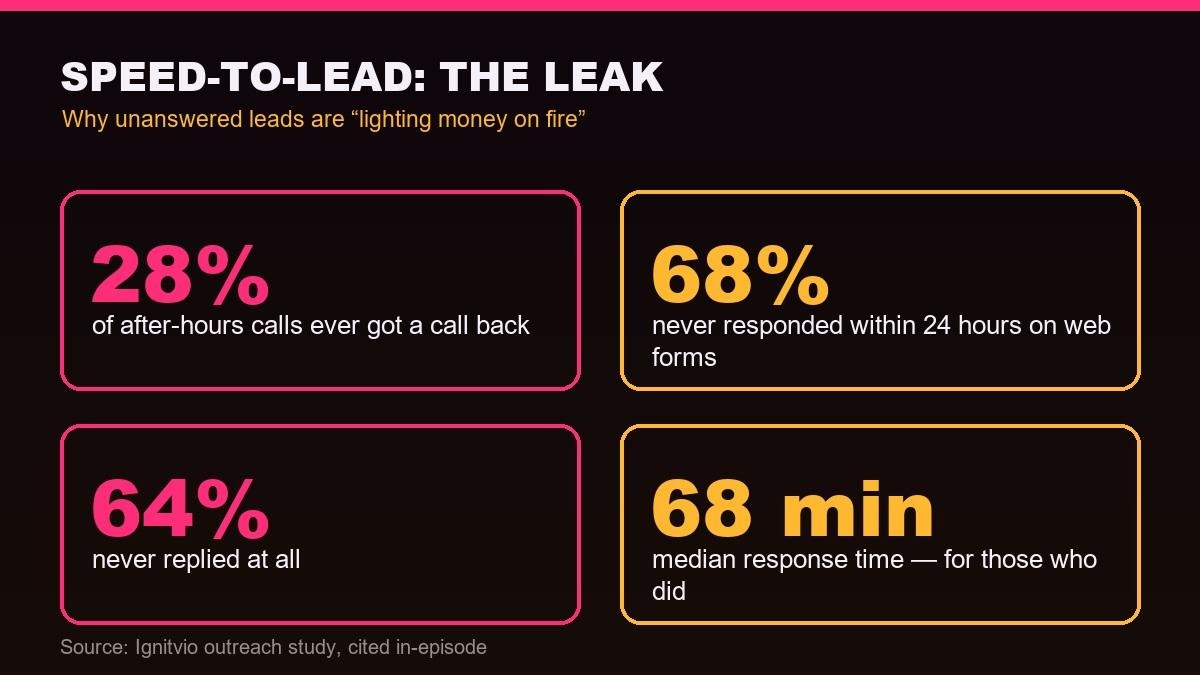
Jeremy Rivera: I just saw this on LinkedIn from Ignitvio. They called like 1,100 businesses after hours, and only 28% ever called back. And then 68% never responded within 24 hours on website contact forms; 64% never replied at all.
Jeremy Rivera: And then, on the forms — on the businesses that did respond — it took 68 minutes. So over an hour. It blows my mind how many service businesses are just leaving all that cash on the table.
Jeremy Rivera: I've run into it personally, like with a consult I did — he's an asphalt guy — and I handed him the hottest lead. My friend was like, "I need a driveway, I need a quote as quick as possible, I'm getting this money, it's going to be gone."
Jeremy Rivera: And so I handed it over to him: "Hey, give this guy a call." He's like, "Yep." And then three days later — my friend never... I never got a follow-up. I'm like, what's going on? You just lit a $20,000 driveway job on fire. He went with somebody else.
Cameron Tope: The LTV, like you mentioned — lifetime value of the client — that has to be a high-ticket job. So it doesn't make sense. You spend money, you want to grow business.
Cameron Tope: I am not a very savvy business owner, but I feel like I bumped my head enough to learn things here and there. Now every time I need a service — we're going to be moving next month, and I start calling around — it just is amazing, like you said, how many people: no professional response, no voicemails.
Cameron Tope: Website contact forms that... you click to submit a form and it just goes into a user error. I wanted to scope out a handful of movers, and it was unbelievable.
Cameron Tope: Now, the one I didn't end up going with — but you could tell when they have their business in line: I called, or I filled out that form, and within minutes I had a phone call. Minutes. Getting some more details from me, and then getting me scheduled with the next person.
Cameron Tope: So you can tell when somebody's actually designed a process to get you from lead to client.
Jeremy Rivera: I subcontracted, gave some SEO advice for Lead Truffle. They do something like AI automation — you input into the form and they call. I think that quote came from that same study, Ignitvio. They'll set up phone numbers, they'll have instant response.
Jeremy Rivera: It's in my top five suggestions when I start working with service-level businesses: hey, what does your fulfillment process look like?
Jeremy Rivera: It goes back even to when I was doing real estate SEO, and they'd call in like, "The website's not working, it's not driving any leads." And I'd look in their inbox and they had four, five, six unresponded emails. And I'm like — it's working. You're not.
Cameron Tope: I can appreciate that. Obviously it's lighting money on fire, right? But I can appreciate serving your current clientele before you go to your leads. But a lot of the time I think it's just ignorance — or people don't understand, or maybe they don't have a good system.
Cameron Tope: You were talking about some of the really cool stuff you're doing with AI and agents — it's like, if you don't have a system for handling stuff... or let's just say it's onerous.
Cameron Tope: There's so much stuff out there that you can go buy off the shelf, or hire somebody to help you out with, so it is easy. It doesn't have to always be arduous. It does not have to be that way. We are in a beautiful age of technology.
AI as delegation, not magic: AARs, screening, and novices vs. veterans
Jeremy Rivera: I think part of it is the scariness level. I eased into the pool too with AI, because I saw all of the hype.
Jeremy Rivera: It's funny, because I actually used an LLM tool — it was called Jarvis at the time, now it's Jasper, because it was before Iron Man came out and was a huge hit. So Jarvis became a whole separate thing, and they had to fight with the rights on that, so it became Jasper.
Jeremy Rivera: But I used an LLM in 2015 to generate content for a marketing site and client project. So I wasn't scared of it; I just didn't figure out then the use of it. And then ChatGPT went crazy in 2023. I'm like, it's all hype.
Jeremy Rivera: But first starting with the web interface — like, okay, there's some limits here, but this could be useful. Then you move into the desktop piece — this I can tie into these tools.
Jeremy Rivera: And now with Mason McCumber, one of my previous guests — he remote-desktopped me in, set me up with a Claude Code instance, and now I've got an MCP connection to Google Analytics, Google Search Console, and OpenSEO all at once.
Jeremy Rivera: So I could do things like: hey, show me what clicks I'm missing in Google Search Console that have organic traffic in Google Analytics, based off my rankings for this page. Boom. It pulls that information for me.
Jeremy Rivera: That would have been multi-day pulls of sheets from this, looking up formulas to match calculations from that. All of these different pools of data that we've had in different places.
Jeremy Rivera: Part of my role is understanding the limitations of different data sets and pulling it together — but I could do so much more now, because it's already connected, and I can scratch those itches on the middle of my back.
Jeremy Rivera: What pages would be beneficial for me to optimize? I can get a better picture with a prompt and a query from my established connections. Versus — let's open Google Analytics, I hate this interface, I can't find any information.
Jeremy Rivera: Now it's all a chat-based interface. And if you can think it, you can probably prompt it. And if you can prompt it, you can either get an answer, an approximate answer, or find who can help you find the answer.
Cameron Tope: And it doesn't have to be anything like what you're talking about — to me that's the next generation, another galaxy operating. I'm just even using it on simple spreadsheets, Jeremy. We do what we call after-action reviews — AARs — after every eviction, and we say, okay, is there anything that we missed?
Cameron Tope: Instead of somebody manually going through all those files when we do a screening process, we can throw that into ChatGPT or Gemini or any of the models and say, hey, is there anything in here that's indicative against our screening criteria?
Cameron Tope: Or at the end of the year, we always update our qualifications based on the evictions we had. Is credit score really affecting this? Is it really somebody who's self-employed versus W-2?
Cameron Tope: Sometimes it's very clear to see, like, okay, we can see a trend here — but this is just another set of eyes to look and go, actually, we do see this. And that has just, like you say, sped everything up.
Cameron Tope: So now I can do more — or what I've been doing is, some of the analytics side I was doing in the past, I've been able to hand off. I just copy in our task: this is the prompt, download the data sheet, copy this prompt in, and it will spit out the result.
Cameron Tope: So it's the delegation piece also. Instead of something that would take hours and a lot of spreadsheets — very technical, not something you could easily delegate to a remote team member or an assistant — you can now delegate very, very easily, as long as you give them those boundaries and framework.
Jeremy Rivera: It is scary in a way, but it's also very freeing. There are aspects where it's like, okay, at some point I might be out of a job. But at the moment, it's a connection of different pools of knowledge.
Jeremy Rivera: I've got this domain information in my head, I've got this tool that gives this information, and this tool. And maybe never the twain shall meet — except through you. So now you can define a process to pull these disparate pieces together and make a stable work.
Cameron Tope: There was some stat in the property management world that said the biggest improvements we're seeing from people using AI are not senior people, not people who are super experienced. Rather, it is the very new and beginner folks — the novices.
Cameron Tope: They're able to jump up and accelerate a six-month training and understanding of a maintenance workflow process — or who the vendor is, or how do you triage a garbage disposal. They're understanding that so much more quickly with AI.
Cameron Tope: As a senior would know that almost immediately without even looking at the process. So the novices get marginally better — and maybe exponentially, depending on their role. The biggest improvements they're seeing are novice people getting up to speed, because they're putting all that senior knowledge into these models.
The give-it-all-away moat: “we can give them the recipe, but it won't taste the same”
Jeremy Rivera: I'm curious on the front-end marketing piece, as you start to explore that SEO side. What are you feeling out as far as appetite from your customers — what you can put out there as a unique knowledge base? This is the other thread of it: why would they come to you and not just ask Claude?
Cameron Tope: I think we're a little bit better insulated — and maybe this is just, you know, asking the barber if you need a haircut type of deal. But because we have tenants, because we have risk, because you have a Texas property code that's changing every so often, we have federal housing laws.
Cameron Tope: I guess you could pull that data in, but then you have to talk to a tenant, which is a human being that acts emotionally, irrationally sometimes. So not all the time do you need a human to interact with that — but there is a certain judgment call that is hard to replicate.
Cameron Tope: And from a marketing perspective, I am a big firm believer in pushing all our information out there. If the web wants to scrape some of that stuff, fine. I have this internal saying with the team, that we can give them the recipe, but it's not going to taste the same.
Cameron Tope: So we give, give, give, give, give. If somebody thinks they could look through our whole workflow on how we screen a tenant — I guarantee it'll take them ten times the amount of time, and they might fumble through something. They still have to do the work; you still have to have a good product.
Cameron Tope: I would be much more concerned if I was working in the technology space — like, I had a maintenance coordination platform in property management; there are several of those that might be built with AI very quickly. Or call centers who support property management. Even the one we have now is rolling out AI agents for a fee.
Cameron Tope: But at some point you'll be able to build these yourself. So not that we're insulated totally from it, Jeremy — but there's that human aspect. And also owners: owners are emotional as well, and they want somebody they can trust, to delegate that liability.
Cameron Tope: So we have some people — we call them delegators as the avatar. They're usually white-collar or blue-collar workers who are super busy and do not want to mess with it. They're like, I'm moving out of state, I want to delegate this. And they want the risk reduced too.
Cameron Tope: Whereas if you're still involved — even if they can do it as good as us, which I don't believe they could — they would own the liability. Somebody wants to file a lawsuit, it's on them, instead of us getting involved.
Cameron Tope: We're the ones that discriminate against a tenant. We're the ones that didn't fix the sidewalk, or whatever it is. So there's also that arm's-length risk piece, where they can delegate and shift some of that risk over to us.
RTMs, remote team members, and the delegation-vs-abdication line
Jeremy Rivera: What are you feeling as far as the changeover of hourly payments for your reps? Are you seeing it as, hey, I get to supercharge my team and they can do more? Versus the mentality some corpos bring — well, we don't need Sally anymore. Humans are the biggest expense, let's get rid of...
Cameron Tope: Labor is definitely — property management is an incredibly labor-intensive business. That's one of the big drags of it. So I look at it as: we have ten-dollar-an-hour people, ten-, fifteen-dollar-an-hour people that we've hired from Nicaragua, the Philippines, Mexico.
Cameron Tope: And these people are not — this was a limiting belief I had many years ago, thinking that for some reason these people don't have the capabilities that we have over here. And they do.
Cameron Tope: We have a licensed accountant for twelve dollars an hour — now, not licensed in US standards, but in the Philippines. We have somebody in Mexico that used to work at the Ritz-Carlton — I mean, customer service — and I get that person for ten dollars an hour.
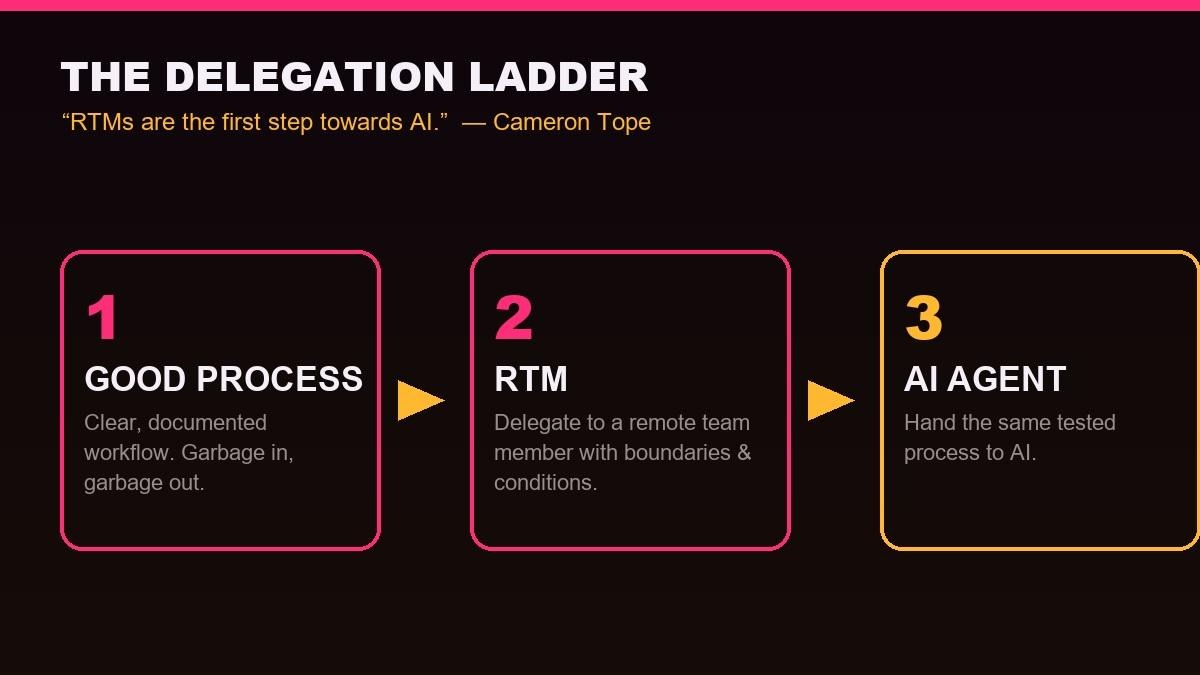
Cameron Tope: And I've heard this before, Jeremy: RTMs — we call them RTMs in our industry, remote team members — they are kind of the first step towards AI. Because if you have a process — you have to have a good process. Garbage in, garbage out.
Cameron Tope: If you don't have a clear process, you can't delegate it to an RTM. And people typically delegate and then get pissed off, because the RTM screwed it up — but they didn't give any boundaries, any conditions, any clear workflow.
Cameron Tope: So if you can do that, that's your first step: okay, if this person can understand it, I can delegate it to an RTM — then I can take the next step to an AI agent. I have a clear set of conditions; maybe they even helped you test it. Now the next step is delegating that to AI.
Cameron Tope: But to get back to your question about hourly rates — I'm not as concerned about that, because we're talking about ten dollars an hour. Less than a hundred dollars a day for most of these folks. If I can't go out and make more than a hundred dollars a day, then I have a problem.
Cameron Tope: So let's say they work five hours a day and use ChatGPT or Claude, instead of eight — I'm going to spend my time and resources making sure I maximize and get that extra thirty dollars an hour out of that person for the day. We're talking two hundred bucks for the week. I don't look at how much can I maximize this person.
Cameron Tope: They also have to have some sort of slack in the system. Like the salesperson — if I want them to pick up the phone every time somebody calls, they have to have that slack. If they're in meetings every single minute of every single day, they can't stop and answer the phone.
Cameron Tope: So you have to be mindful of what this person is supposed to be doing. And if they're supposed to jump on something quickly, you have to give them that flex. There might be nothing, nothing, nothing — and all of a sudden, emergency.
Cameron Tope: The biggest analogy would be a fire department. I don't want my fire department stretched to the nth degree, running from fire to fire. I want them sitting there ready, so when I pick up the phone and need them, they're there.
Cameron Tope: So you could look at tech utilization rate and maybe obsess over it. If you're talking about high-skilled or high-dollar labor, that becomes more imperative — management level might be different. But as far as technicians and the RTMs, I don't concern myself too much with it, Jeremy, to be honest.
Remote ops and offshoring pitfalls: the Raven Tools story
Jeremy Rivera: That's fair enough. I'm curious what your experience has been on that remote side. I've run into it successfully and unsuccessfully. So Raven Tools — Nesio SaaS — got bought up by TapClix, another SaaS. And they determined that our three American customer support reps, handling all the tickets, could do that better in Colombia.
Jeremy Rivera: So they offshored it. And the problem became they very quickly let go our experienced, knowledge-domain folk who had all of the answers. Technically everything was written down; technically you could figure everything out.
Jeremy Rivera: But these tickets would take too long, and the depth of knowledge needed to be more than what you could quickly look up in the knowledge base. You had to know how the internal tool functioned — like, yes, that's a data source for this SERP result, but actually it's pulling from this, and it has these problems.
Jeremy Rivera: That's something where you need a higher level of savvy behind it. And so the painful part was, they had to hire back Lance. And they had to pay him twice as much as he was getting paid before to convince him to come back.
Jeremy Rivera: He said, I want a guarantee, a twelve-month contract, twice as much pay, twice as much vacation payment — like, you get Lance, you cornered him. Because the tickets were bad, and the churn went through the roof, because satisfaction just dropped.
Jeremy Rivera: I'm curious if you've had a similar experience — or have leapt those hurdles and used software, or just experience and structure, to successfully remoticize your business.
Cameron Tope: Yeah. Another reason a lot of people fail with RTMs is they try to give them big things. Customer service especially — there are so many tentacles that it's a huge black box, and needs some knowledge base, FAQ, structured thing the person can query or reference.
Cameron Tope: So what we've done is created FAQs. Very simple stuff, Jeremy — nothing crazy. Every time a question comes up — we'll say on our resident side, that's a great question, this is unique. If a tenant wants to break their lease, what happens? This doesn't happen very often, so we have an FAQ.
Cameron Tope: He just goes in and simply adds that, or goes into a dedicated little chat — he has a project — and asks it the question, and it brings it out. So if you don't have that, and you're not willing to teach them... A lot of people, too — I've heard the difference between delegation and abdication.
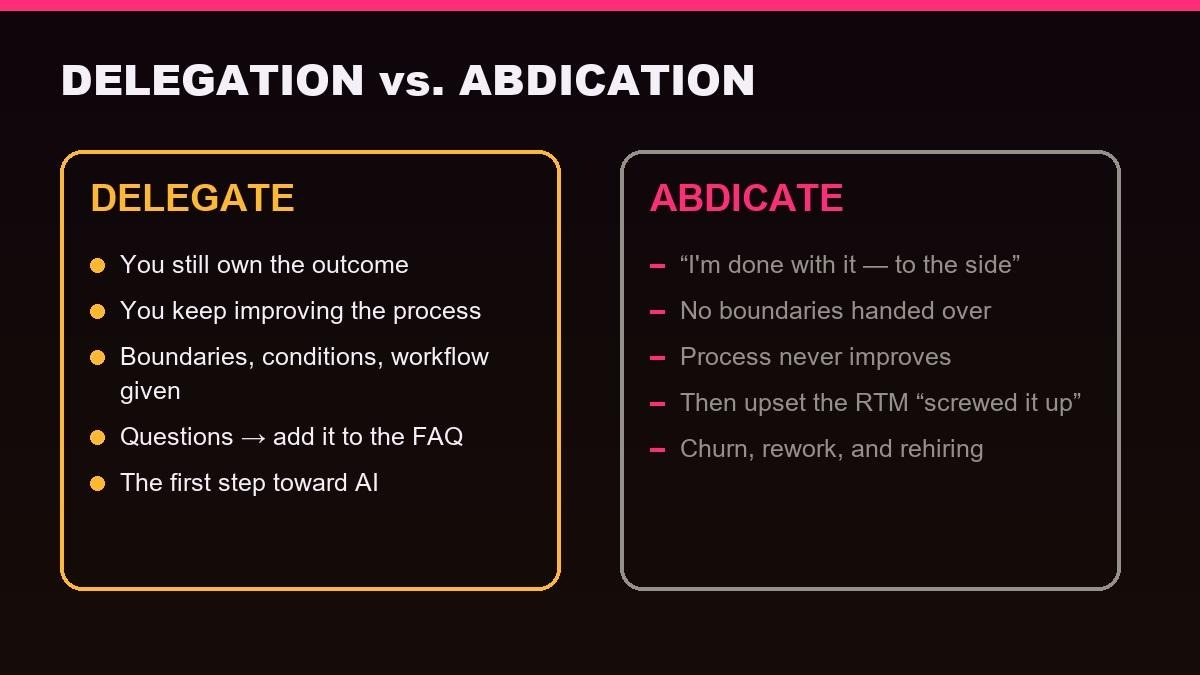
Cameron Tope: When you abdicate, you're just saying, I'm done with it, it's to the side, I don't want to hear about it anymore. And I think people abdicate instead of delegate. When you delegate, you're still improving that process.
Cameron Tope: So we also try to silo decision-making — strategic decisions — from execution. Handling a garbage disposal has a very clear set of instructions. Determining a maintenance repair strategy for large capital-expenditure items — HVAC, roof, plumbing — that sits with the asset manager still.
Cameron Tope: So there are levels to this. We wouldn't put Andy, or one of our RTMs, in the place to make a ten-thousand-, twenty-thousand-dollar decision. Maybe we'll get to that place, where we have all that process systematized as well.
Cameron Tope: But people lump all that stuff together, and then they're upset that their RTMs aren't making these strategic decisions. Again — they don't have the knowledge base. So you have to be willing, once you hire that person, to help them when they ask questions. Not get upset, but say: is that in the FAQ? No? Add it to the FAQ.
Cameron Tope: Now, Jeremy — I remember hundreds of pages of Google Sheets, trying to find stuff, and you control-F. Now you can dump all that into these projects, ChatGPT or whatever, and just ask it. Hey, what's our process when a tenant breaks a lease, or wants to move out early? And if we don't have that answer, we just add it in.
Cameron Tope: So that's the thing — people try to bundle the whole thing together. And maybe because the first hire, especially for me, they're generalists. You have to hire that way, because you don't have the revenue to support a bunch of specialists. So separate the executable, clearly-defined things versus larger strategic items, or things with a lot of tentacles like customer service.
Jeremy Rivera: My friend Matt Brooke at SEOteric does the same thing, but has a specific ChatGPT warehouse and knowledge base that he's building. His team uses it, and then it also gets turned into content for the blog.
Jeremy Rivera: The questions that you're getting answered — that's friction, right? Any question they ask is a heat signature of something in the process that needs to be cleared. So the more you can grease the skids proactively — usable content, a download, a blog post, a training course, a PDF, an ebook, a slide deck.
Jeremy Rivera: For your existing customers, they can see that and, before they call you, remove that blocker. And it does double duty: those who don't know you and are looking for that answer in the void — you supplied it, so your chances of being the person they contact just went up, because you're showing that domain expertise.
Jeremy Rivera: But that's the feedback loop that's been so broken in SEO. We've been too isolated. There was one agency I worked with where I did their SEO for a year and never spoke with anybody on their team.
Jeremy Rivera: I was the SEO, assigned to the account lead, who had on the opposite side an account manager, who on the customer side interacted with the C-suite. So it was a game of telephone every single time. I think about how much was left on the table as far as domain information.
Jeremy Rivera: Were there leads we generated? A whole bunch. Were they the best? No feedback loop. So now — if you can get an MCP to your CRM — your Claude or GPT can make a connection through another acronym, API, into these programs, and you can marry these two data sets. So do everything you can to connect everything you can. Just plug it all in.
Theory of constraints: focus is the scarce resource now
Cameron Tope: I couldn't agree more, Jeremy. There is so much low-hanging fruit in most people's businesses. I'll give you an example — and I forget who this was — but they said they spent all this time designing a new Calendly, as a replacement for Calendly. And if you think about that, you've just saved two hundred bucks a year.
Cameron Tope: Is that really the largest constraint? I think now we go back to Goldratt and the theory of constraints. That now is so critically important.
Cameron Tope: Because if you don't have stuff connected, you might just look at something you enjoy. You're like, I really like playing around with the marketing side, or the operations, so I'm going to build this little widget, or this agent that solves this. But is that your largest constraint?
Cameron Tope: If you're not getting any leads, who cares if the turnover has been optimized, or how you triage your garbage disposal has been optimized, if you're not getting the leads you want? You might have all your maintenance optimized. Great. But should that energy not be spent where the constraint is — maybe your marketing, maybe your leads?
Cameron Tope: And with the flurry of things you can do — I don't know who said this, but they're like, focus is the most important thing. Now that you have unlimited things in your hands, where you don't have to be a coder anymore, don't have to be a software developer to get an API or create agents, or have agents working with other agents to deliver stuff — vibe coding is so prevalent now.
Cameron Tope: So I just think it's attention. It's where are you going to spend your focus.
The roadmap: own Houston, build a life, don't sell
Jeremy Rivera: I'm curious what's next on your business roadmap. Is it more locations? Franchising? Is franchising even something you believe in? Or do you just want to make as comfortable a lifestyle business as you can right now?
Jeremy Rivera: And no shade — because I think honestly it's a time for us to reflect. If we can gain back some of our time, does that mean maybe we rework the heavy focus of gotta get leaner, gotta get more profitable — and build into the system more leisure time, more flexibility, and create happier workers who want to stay with you longer?
Cameron Tope: A hundred percent, Jeremy. The majority of the owners we have today are owners that I onboarded myself. And I would always tell them: why are you buying real estate? What do you want this piece of property to do for you? To retire yourself, your spouse, give you some vacation money? If you don't know, then you're just flying around blind.
Cameron Tope: And I see that same thing with business owners. When I go to these networking events, there shouldn't be any shade to have a lifestyle business. And there shouldn't be any shade if you want to grow this thing and sell it to a PE company, or take on venture capital. That's fine.
Cameron Tope: But for us, I am not interested in selling this business anytime soon. I've been doing this with my own stuff for over ten years, and I feel like I'm just scratching the surface. There's so much excitement with the stuff you're talking about — the AI agents and what that can do. We have so much opportunity.
Cameron Tope: It's more like this problem that needs to be solved, and it's like a puzzle. How can we deliver better service? How can we get maintenance triage more quickly? How can we get our owners responded to more quickly? How can we get a property performing better, making more income? And we can use these tools at our disposal to help us.
Cameron Tope: So we just want to own Houston. Like I mentioned, I sit in San Diego, but we really just want to own the Houston market. Maybe at some point, if we have a few thousand doors and we've tapped that market, then maybe we'll go elsewhere. But we've got a few years for that.
Cameron Tope: And with technology now — if you enjoy the challenge of business, and you enjoy your delivery of that service, whether it's a product or service — how can you not be excited?
Where to find Cameron
Jeremy Rivera: So, wrapping up — I'm giving you an off-ramp. Lead into some of the content you've created recently on your site. Shout out for your brand if people want to connect with you. Where are the best ways to do that?
Jeremy Rivera: And if you've had any great other podcast conversations with other hosts — shame on you, you're only allowed to interview with me. I'm kidding. I'll include those links in the show notes for anybody listening.
Cameron Tope: Jeremy, I appreciate it — I appreciate having you on again. It really does feel like a conversation with you, man. For us, EmersonPropertyManagement.com has everything.
Cameron Tope: If you are a property owner and you're having trouble selling, there's an accidental landlord guide that I created on there that'll walk you through everything to help you determine whether you want to turn that into a rental or just sell it.
Cameron Tope: There are tools on there, if you own a couple of rental properties — ones we use to help you with collecting rent, screening tenants, whatever it might be. There's a lot of great free information on there, and we give all that away for free. So go there, or you can search my name and it'll pop up.
Jeremy Rivera: Well, thanks for coming on. And for my listeners — this interview will be up on the site this afternoon. I'm going to give a recap version of it to Cameron to put up on his site as well. I'll make sure that episode has links to his previous episode, so check out that full conversation. Thanks for listening.
Key Takeaways
→ Speed-to-lead is the cheapest growth lever there is — $20k/month in marketing means nothing if nobody answers the phone; Cameron's first two hires were a salesperson to close inbound owner calls and a marketer.
→ Agent referrals + “accidental landlords” (owners who can't sell in a higher-rate, higher-inventory market) are the core of Emerson's marketing, layered on top of SEO he only switched on once operations were solid.
→ AI is a delegation tool, not a magic box: AARs after evictions, screening-criteria checks, and analytics get handed off with a saved prompt — the biggest gains go to novices, who absorb senior knowledge fast.
→ “RTMs are the first step toward AI” — a good, documented process you can delegate to a $10–$15/hr remote team member is the same process you later hand to an agent; delegation means you keep improving it, abdication means you drop it.
→ The moat is human, not informational: give away the whole recipe, because risk, liability, the Texas property code, and emotional tenants/owners mean “it won't taste the same” when someone else tries to cook it.
→ Apply the theory of constraints: with unlimited things you can now build, focus is the scarce resource — spend energy on the actual bottleneck (usually leads), not the widget you enjoy building.
.jpeg)